

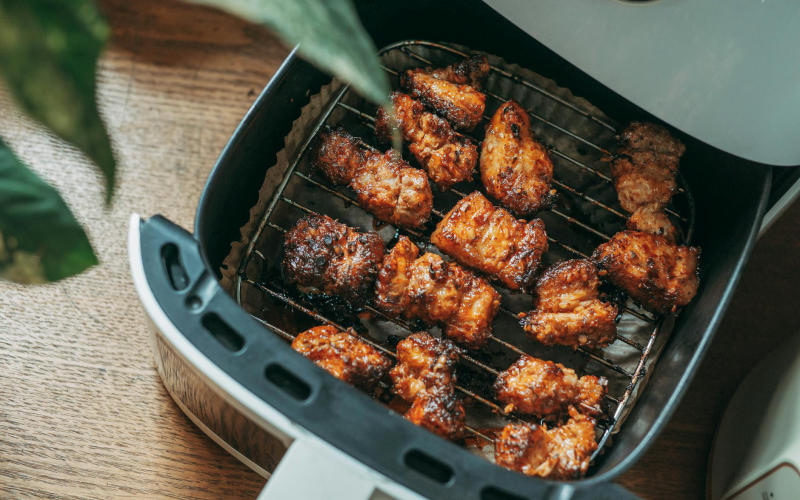
Here’s the uncomfortable truth most buying guides won’t say out loud: for a lot of households, the air fryer vs convection oven debate was settled the moment hybrid countertop ovens got good enough to do both. And yet the air fryer keeps winning hearts on Reddit threads and Amazon wishlists — often for reasons that crumble the second you run actual numbers.
I’ve been cooking with both for years. I own a dedicated basket air fryer and a countertop convection oven, and I’ve watched my electricity bill carefully enough to know that the “air fryers save you money” headline is technically true but genuinely misleading if you skip the fine print. So let’s work through this properly.
The Energy Cost Gap Is Real — But Maybe Not As Big As You Think
The raw numbers are genuinely interesting. According to SantAnna Energy Services, using the U.S. average electricity rate of $0.1644/kWh as of February 2026, a full-size electric oven burns roughly 3.5 kWh per hour (about $0.58/hr), while a standard air fryer draws around 1.4 kWh per hour (about $0.23/hr). Less than half the energy for the same cooking window. On paper, switching from oven to air fryer for 30 minutes of daily cooking saves you roughly $10.36 a month.
But here’s the catch nobody puts in the headline. Those savings only exist if the air fryer completely replaces your oven use. If you’re running chicken thighs in the air fryer while the oven handles roasted vegetables, you’ve just increased total energy consumption — not cut it. That’s not a hypothetical. It’s a real behavioral pattern that shows up repeatedly in testing, where the appliance you bought to save money quietly becomes an addition to your electrical load rather than a substitute for one.
The break-even math can be brutal, too. A quality dedicated air fryer like the Cosori TurboBlaze or Ninja Foodi DZ550 runs $80–$180. At $10.36 in monthly savings, you’re looking at 8–17 months to recoup that cost under ideal conditions. Buy the Breville Smart Oven Air Fryer Pro at around $400, and that math stretches well past three years. Worth knowing before you click “add to cart.”
Speed: Air Fryers Win Small, Lose Big
Air fryers are genuinely faster for small portions. Research from chefapprovedtools.com (December 2025) found a 20–25% speed advantage over convection ovens for comparable items at one to two servings. In head-to-head testing by SavoringTales in 2026, the Cosori TurboBlaze shaved a full three minutes off fry tests against a Gourmia countertop convection oven. Three minutes sounds trivial. At 400°F on a weeknight when you’re starving, it doesn’t feel trivial.
Now factor in a family of four. Most basket air fryers top out at 4–6 quarts, which means you’re cooking in batches — batch two goes in while batch one sits cooling on the counter, losing its crunch by the second. By the time you plate everything, the convection oven, which fit the whole meal at once, has already finished and rested. The speed advantage disappears entirely. For families, the convection oven isn’t just competitive; it’s usually faster overall, and the air fryer’s headline advantage quietly reverses.
Crispiness: This Is Where Air Fryers Actually Earn Their Hype
I’ll admit something. I was skeptical of air fryers for a long time. longer than I should have been. Then I made chicken wings at 400°F for 22 minutes in my basket fryer and understood the hype immediately. Not just good. Genuinely different from what my convection oven produces.
The technical reason is straightforward: air fryers use a more powerful fan relative to their chamber size, with a heating element positioned much closer to the food and a perforated basket that allows airflow on all sides simultaneously. A convection oven circulates air too, but the chamber is larger, the fan is proportionally weaker, and food sits on a solid pan that blocks bottom airflow entirely. You can nudge a convection oven toward air fryer results by using a rack and cranking the fan, but you rarely hit the same crunch level on breaded coatings, chicken skin, or potato surfaces, and it takes longer to get close.
This is the one domain where the dedicated basket air fryer has a legitimate, meaningful edge, and most people buying them have figured that out instinctively, even if they couldn’t explain why.
The Hybrid Category That Changes Everything
Here’s what most air fryer vs convection oven comparisons miss entirely: the category distinction is becoming obsolete. The Cuisinart TOA-70NAS, the Breville BOV900, and the KitchenAid Dual Convection Countertop Oven all offer dedicated air fry modes alongside full convection baking capability. Taste of Home named the KitchenAid Dual Convection its top overall pick in April 2026. Tom’s Guide went with the Ninja French Door Premier as their best toaster oven for 2026, citing its combined air fry, bake, and convection functionality.
The Cuisinart TOA-70NAS has over 7,000 reviews averaging 4.4 stars. The Breville BOV900 matches that rating exactly, runs about $400, and packs 13 cooking functions into a footprint that replaces two appliances. Not as a gimmick mode. as a real functional upgrade.
| Appliance | Cost | Capacity | Energy (per hr) | Best For |
|—|—|—|—|—|
| Basket Air Fryer (e.g., Cosori TurboBlaze) | $80–$180 | 4–6 qt | ~1.4 kWh | 1–2 person households |
| Countertop Convection Oven (basic) | $60–$150 | 0.6–0.8 cu ft | ~1.8 kWh | Small families, baking |
| Hybrid Air Fry + Convection (e.g., Breville BOV900) | $300–$400 | 1.0 cu ft | ~1.5–1.8 kWh | Families, versatile cooks |
| Full-Size Electric Oven | Built-in | Full capacity | ~3.5 kWh | Large meals, entertaining |
Maintenance, Kitchen Heat, and the Stuff Nobody Mentions
Air fryers need cleaning after every single use. Grease builds up in the basket and on the heating element fast, and it affects both flavor and fire safety, this isn’t optional housekeeping, it’s structural to using one safely. Convection ovens, by contrast, need a proper clean maybe every few months depending on use. That time cost is real if you’re cooking daily, and nobody puts it in the product description.
So is ambient kitchen heat. Running a full-size oven for 45 minutes raises the temperature in a small kitchen noticeably. particularly in summer, when that warmth gets absorbed by your air conditioning and tacks onto your cooling bill in ways that wattage comparisons never capture. A compact air fryer generates a fraction of that ambient heat. In a warm climate or a cramped apartment kitchen, that distinction actually matters come July.
What I’d Actually Buy (And Who Should Buy What)
Here’s my honest verdict: if you’re cooking for one or two people, a quality basket air fryer in the $100–$150 range makes complete sense. Fast, energy-efficient at small scale, and genuinely excellent for the foods that shine in it, wings, fries, reheated pizza, salmon fillets. The Cosori TurboBlaze and Ninja Foodi DZ550 are both worth the money.
Feeding three or more people regularly? Or do you bake, or want to roast a whole chicken without doing it in two bitter rounds? Buy the hybrid.
The Cuisinart TOA-70NAS or the Breville BOV900 cost more upfront, but they collapse two appliances into one footprint, handle larger quantities without the batch-cooking penalty, and deliver crispiness that’s genuinely close to a dedicated air fryer. The air fryer has better marketing. The hybrid convection oven with an air fry mode is almost always the smarter purchase. and I’d rather you knew that before you spent $150 on something that only works well for half your cooking life.
Does an air fryer actually cook differently than a convection oven, or is it marketing?
It’s a real difference. Air fryers use a proportionally stronger fan and closer heating element with all-around airflow through a perforated basket. The result is noticeably crispier food, particularly on breaded items and chicken skin, compared to most countertop convection ovens.
Is it worth buying both a dedicated air fryer and a convection oven?
Rarely. Unless you’re cooking large meals and small crispy snacks simultaneously every single day, a hybrid unit like the Breville BOV900 or Cuisinart TOA-70NAS covers both needs more efficiently and takes up less counter space.
How much does an air fryer actually save on electricity per year in the US?
Based on SantAnna Energy Services’ February 2026 analysis, switching from a full electric oven to an air fryer for 30 minutes daily saves roughly $124 annually at U.S. average rates, but only if the air fryer fully replaces those oven sessions rather than supplementing them.
Photo by FOX ^.ᆽ.^= ∫ on Pexels