
Most salsa recipes are solving the wrong problem. They obsess over tomato variety, chile ratios, the exact moment you add the cilantro — all fine, all worth caring about. But the single technique that creates genuinely complex, layered, restaurant-quality salsa? Skipped entirely by almost everyone cooking at home. That technique is lacto-fermentation, and I’d argue it’s the most criminally underused tool in a home cook’s arsenal.
Here’s the part most food blogs won’t say out loud: a properly lacto-fermented salsa is actually safer than fresh salsa that’s been sitting in your fridge for three days. The lactic acid produced during fermentation drops the pH below 4.6 — the threshold at which botulism and most pathogens can’t survive, confirmed by both the USDA’s National Center for Home Food Preservation and research documented at the National Library of Medicine. Fresh salsa left in an open container? That’s where Salmonella feels right at home.
So why isn’t everyone doing this? Fear. Mostly unfounded.
Why Your Salsa Tastes Flat (And What’s Missing)
Fresh salsa is bright. Punchy. Immediate. It’s also one-dimensional in a way that’s genuinely hard to articulate until you taste the fermented version alongside it. That raw garlic bitterness that occasionally hijacks a fresh batch? Gone. mellowed into something almost buttery. The sharp onion bite that lingers on your breath for two hours? Rounded into something approaching sweetness. What you get instead is a salsa with real depth, tangy, faintly fizzy on the tongue, with flavors that build rather than spike and vanish.
That complexity is entirely microbial. Specifically, it comes from Lactobacillus and Leuconostoc bacteria naturally present on the surface of your vegetables. Submerge those vegetables in a 2–3% salt brine and those bacteria get to work, producing lactic acid and CO2 as they consume sugars.
Here’s something almost no recipe bothers to explain: Leuconostoc strains actually initiate fermentation first, generating the early acidity and that CO2 bubbling you’ll see, before Lactobacillus takes over and deepens the sour, complex character. This is why Day 1 looks completely inert and Day 2 suddenly fizzes like something woke up. If nobody told you that’s supposed to happen, you’ll throw out a perfectly good batch convinced you did something wrong.
The Salt Rule That Kills More Batches Than Anything Else
Salt is everything. The mistake I see constantly. in Reddit threads, in YouTube comment sections going back to at least 2019, is people reaching for iodized table salt. Don’t. Iodine inhibits the exact bacteria you’re trying to cultivate, blocking fermentation and rolling out the welcome mat for mold instead. Use kosher salt, sea salt, or pickling salt. I’ve been using Redmond Real Salt for over a year. no anti-caking agents, no iodine, just mineral-rich unrefined salt, and it works beautifully every time.
Now here’s what almost no salsa guide mentions: measure by weight, not volume. A teaspoon of fine sea salt weighs meaningfully more than a teaspoon of coarse kosher salt. Recipe writers who give you “1 teaspoon” without specifying the grind are quietly setting you up for inconsistency. The reliable standard is 2% salt by weight of your total ingredients. Weigh your chopped vegetables and liquid, multiply by 0.02, done. Thirty extra seconds. Eliminates the single biggest variable in the whole process.
Too little salt and spoilage bacteria outrun the lactic acid bacteria before fermentation can establish itself. Too much and fermentation stalls completely. Two percent is the sweet spot. not an approximation, an actual target.
The Actual Process (It’s Simpler Than Canning)
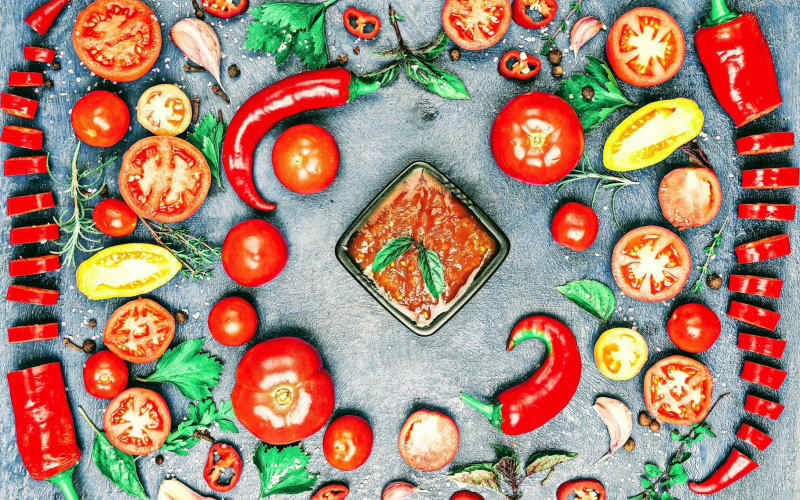
Start with roughly 2 pounds of chopped tomatoes. Roma tomatoes work reliably, but high-water-content heirlooms like Beefsteak or Big Boy generate enough natural brine to keep everything submerged without adding extra water, a small but genuinely useful advantage. Combine with diced white onion, jalapeños, garlic, cilantro, and lime juice. Add your 2%-by-weight non-iodized salt, mix thoroughly, and pack tightly into a wide-mouth mason jar.
The step most beginners skip: keep the vegetables submerged below the brine. When they float up and meet oxygen, surface mold develops. and that’s the moment people spiral into “fermentation is dangerous” panic and swear off the whole enterprise. You can use a Masontops Pickle Pebble glass weight (food-grade, lead-free, designed specifically for wide-mouth jars) or, honestly, just fold a cabbage leaf over the top and jam it under the shoulder of the jar. Both work. No special equipment is actually required.
Cover loosely. A Masontops Pickle Pipe airlock lid earns its keep here because it lets CO2 escape without admitting oxygen, meaning you’re not hunting down the jar twice a day to burp it. Leave everything at room temperature for 2–4 days. In summer, two days is often plenty; in winter, budget four or five. Start tasting at Day 2. You want a pleasantly sharp, sour smell and a faint tingle on your tongue, not rot, not acetone. Just tang.
The Shortcut Most Advanced Recipes Still Skip
Want to accelerate both fermentation speed and flavor complexity? Add 2–3 tablespoons of lacto-fermented pickle brine as a starter culture. The brine from Bubbies Kosher Dill Pickles is ideal. cloudy, vinegar-free, carrying live Lactobacillus cultures. Olive My Pickle’s LiveBrine works identically. This jumpstarts the microbial community fast and, according to fermentedfoodlab.com (April 2026), adds a flavor dimension you simply won’t get from a fresh-start ferment alone.
A word on whey starters, which you’ll encounter in older fermentation guides: skip them. Salt-only wild fermentation selects for bacteria already living on your local produce, producing what I’d call terroir-driven salsa, flavors specific to your ingredients and your particular kitchen environment. Whey introduces a more generic commercial culture that actually flattens that local character. It’s the fermentation equivalent of using a kit wine grape instead of whatever grows in your backyard.
Comparison: Fermented vs.
Fresh vs. Store-Bought Salsa
| Factor | Fresh Homemade | Store-Bought | Lacto-Fermented |
|—|—|—|—|
| Shelf life | 3–5 days | 1–2 years (sealed) | 3–4 months refrigerated |
| Live cultures | None | None (pasteurized) | Yes. active Lactobacillus |
| Flavor complexity | Bright, one-note | Flat, vinegary | Layered, tangy, umami |
| Safety once open | Moderate risk | Low risk | Low risk (acidic pH) |
| Equipment needed | None | N/A | One jar, right salt |
Almost every store-bought salsa, every single major brand. is vinegar-acidified and heat-pasteurized. Zero live cultures. Nothing fermenting. The word “fermented” on a label means precisely nothing unless the brine is visibly cloudy and the product has been refrigerated since production. Don’t let clever marketing confuse the two.
What I’d Do If I Were Starting This Today
I’d ferment a batch this weekend and push it to five or even six days instead of the standard two. Extended fermentation past Day 4 develops an almost umami-forward depth that most recipe writers flag as “too much”, but that’s a flavor preference, not a safety concern, and I’d rather decide that for myself. A 6-day fermented salsa alongside braised pork or slow-cooked beans is a genuinely different eating experience from anything you’ll pull off a grocery shelf.
Not ready to start from scratch? Wellness Mama has confirmed you can lacto-ferment store-bought refrigerated salsa simply by stirring in non-iodized salt and leaving it out. Five minutes of effort. Your worst outcome is a batch that tastes unremarkable. Your best outcome is stumbling onto a technique you’ll reach for the rest of your cooking life.
FAQ
How do I know if my fermented salsa has gone bad versus just fermenting?
Trust your nose. it’s a reliable instrument here. Active fermentation smells tangy and sour, sharp but somehow appetizing, like good sourdough with heat behind it. Spoilage smells genuinely rotten, putrid, or weirdly chemical, like acetone. Surface mold, usually white or pink fuzz. means your vegetables weren’t fully submerged. Scrape it off if it’s purely surface-level; discard the batch if it’s worked down into the salsa itself.
Can I use canned tomatoes instead of fresh?
You can, but expect a flatter ferment. Canned tomatoes are heat-processed, which wipes out the surface bacteria that kick off wild lacto-fermentation. If you go this route, add Bubbies brine or another live-culture starter to compensate, otherwise you’re just making salty tomato mush and waiting.
Does fermented salsa still work if my kitchen runs cold in winter?
Yes. Just extend the timeline. At 65°F or below, budget 5–6 days instead of 2–3. Cold slows the bacteria without stopping them. Same process, more patience, same result.
Photo by Kunal Murumkar Patil on Pexels