

Here’s What Nobody Tells You
My first Memorial Day cookout for twenty people nearly broke me. Not emotionally — though honestly, close — but financially and logistically. I’d budgeted based on vibes, planned to grill everything simultaneously, and told myself I’d prep “the morning of.” By 2 p.m., guests were hovering around a grill that couldn’t keep up, potato salad had been sitting in 87°F heat for ninety minutes, and I was sweating through a shirt I’d put on clean forty-five minutes earlier.
So read this before you make a grocery list. Most hosting tip articles are either hopelessly vague or quietly outdated — and in 2026, with food prices where they are right now, that gap between generic advice and reality will cost you real money. Specific, embarrassing, avoidable money.
The 2026 Price Reality Check Nobody Is Talking About
Here’s the uncomfortable truth: if you budgeted based on what a Memorial Day cookout cost last year, you’re already short. The Century Foundation and Groundwork Collaborative released a report in May 2026 showing that classic barbecue staples are up 13% year-over-year on average. Ground beef has hit $7.46 per pound at many retailers. up from $6.22 in 2025, a 20% jump, driven by U.S. cattle inventories dropping to their lowest level in over 70 years. Six ears of yellow corn now average $5.90, compared to $2.97 last year. That’s a 98% increase. On corn.
For twenty people, this math stings fast. The average cookout for eight runs roughly $68 in 2026 according to Parade.com figures; scale that up and you’re looking at $160–$175 just for basic food, before drinks, ice, condiments, or anything extra. And the BLS April 2026 CPI data shows beer is up 2.2% and carbonated drinks up 3.7%, so your beverage budget isn’t safe either. Nothing is safe.
The smartest pivot I’ve seen for 2026? Ditch the traditional full beef spread entirely. Chicken thighs are still reasonable, pork shoulder feeds a crowd affordably, and if you’re committed to burgers, Aldi’s 5-lb ground beef roll at around $3.49/lb runs significantly cheaper than Kroger or Meijer. A focused two-protein menu. executed well, beats a chaotic four-protein spread every single time. Pick your battles. Win them.
Your Grill Cannot Feed Twenty People.
Here’s What Can.
This is the part most articles completely skip, and it’s the part that will ruin your afternoon if you ignore it. A standard two-burner gas grill has roughly 400–500 square inches of cooking space. A Weber Genesis SX-335 gives you 513 square inches on the primary grate. Sounds like a lot. until twenty burgers need multiple rounds, and you’re also trying to run chicken, hot dogs, and corn simultaneously. That’s not a cookout anymore. That’s a cold-food crisis with patriotic decorations.
The Men’s Journal 2026 Grilling Awards named the Blackstone Original Omnivore as best budget flat-top griddle, and for large-group cookouts, a flat-top genuinely changes the whole game. Fifteen smash burgers at once. Vegetables that don’t disappear through the grates. A full row of hot dogs running parallel to a full row of patties, no babysitting required. The Weber Slate 28-inch griddle is the premium version, pre-seasoned, tested above 708°F, genuinely rust-resistant. but the Blackstone is where most first-timers should start. Borrow one before you buy anything.
Cook in waves. Assign someone to run the grill with you, don’t be a martyr about it. And get a Typhur InstaProbe or a Thermoworks RFX; the Men’s Journal picked both as best-in-class thermometers for 2026, and you need one. Color is not a reliable doneness indicator, per the USDA. Ground beef needs to hit 160°F. Poultry hits 165°F. Not optional when you’re feeding twenty people who trusted you.
The Potluck Assignment Is Not a Cop-Out
I used to feel genuinely weird asking guests to bring things. It felt like admitting I couldn’t handle it. I was wrong. Assigning specific dishes to specific people. not “bring whatever” but “can you bring a pasta salad for twelve?”, is one of the highest-use moves a first-time host can make, especially this year when food costs are legitimately painful.
Most guests actually prefer a specific assignment over showing up empty-handed and guessing. Frame it as collective investment in the feast. Delegate drinks to one person, dessert to another, a side to a third. You handle the proteins and the grill. That’s your job. That’s enough. more than enough, actually.
Cold Food Is a Bigger Risk Than Undercooked Meat
The USDA’s Food Safety and Inspection Service warns that bacteria double every 20 minutes in the danger zone between 40°F and 140°F. Perishable food left out more than two hours, or just one hour when temps exceed 90°F. is already in unsafe territory. Teresa Eury, a registered dietitian at Cleveland Clinic, puts it plainly: keep cold foods cold and hot foods hot. Obvious advice. Shockingly easy to ignore when you’re also managing the grill, refilling ice, and trying to find a bottle opener.
Two coolers. Non-negotiable for twenty people. One dedicated to beverages, because that lid gets opened every three minutes and destroys your ice. and one sealed for food, opened only when you’re actively serving. Keep the food cooler in shade. Pull items out in batches, not all at once. And if it’s been out two hours and guests are still grazing? Toss it. I know it hurts. Not worth the risk.
The Night-Before Prep Rule Changes Everything
Stop planning to do everything the morning of. I cannot stress this enough. When guests started arriving at noon at my first cookout, I was still forming burger patties in the kitchen, chairs weren’t set up, and I hadn’t once thought about where twenty people were going to sit in the shade. Not once.
Do all of this the night before: form and season your patties, make your pasta salad (it genuinely tastes better after sitting overnight), prep your toppings, load your coolers, and organize your supply table. Morning of, your only jobs are lighting the grill, setting out pre-made sides, and being a host. Not a line cook. There’s a real difference between those two roles, and your guests will feel it either way.
Shade, Seating, and the Stuff That Actually Keeps People There
Most first-time hosts over-invest in decorations and under-invest in chairs and shade. Patriotic tablecloths are fine. Enough seating for twenty people out of direct sun is essential, and those are not the same category of priority. Guest comfort determines how long people stay and whether they actually enjoy themselves, or just endure the afternoon out of politeness.
Memorial Day 2026 weekend brought severe thunderstorms and tornado threats across parts of the country, which is a useful reminder: have a weather backup plan. Know exactly where you’re moving twenty people if a storm rolls in. Also, and I say this from experience: bug spray, sunscreen, and a clearly labeled trash station. These feel like small things. At hour three, they’re the whole thing.
What I’d Actually Do Differently
I’d borrow a Blackstone griddle before buying anything. I’d shop Aldi for ground beef without apology. I’d send a potluck assignment text two weeks out and not spend one second feeling weird about it. And I’d set a hard budget at 15% above whatever I spent last year. because 2026’s price increases are real, they’re documented, and they will catch you off guard at checkout in a way that’s deeply unpleasant.
The cookout itself is actually the easy part. Once your prep is done, the food is moving in waves, and your guests have a cold drink and a chair in the shade, you can relax. That’s the whole point. Don’t let the logistics steal it from you.
FAQ
How much food do I need for 20 people at a Memorial Day cookout?
Plan for roughly 1/3 pound of cooked meat per person for a main meal, but add 20% for a long grazing event. For twenty people, that’s about 8–9 pounds of cooked protein. For sides, count 4–6 ounces per person per dish, and have at least three sides.
What’s the safest way to handle potato salad and coleslaw at an outdoor party?
Keep them in a sealed cooler until you’re ready to serve, then pull out half at a time. After two hours outside, one hour if temps are above 90°F. discard what’s left out, per USDA guidelines. Don’t try to “save” anything that’s been sitting.
Is a flat-top griddle actually worth buying over a traditional grill for a big cookout?
For groups of fifteen or more, yes, I’d argue strongly in favor of it. A Blackstone Omnivore runs around $300–400 and can cook twenty burgers simultaneously. A traditional grill can’t match that throughput, which means guests wait, food gets cold, and you’re stressed the whole afternoon.
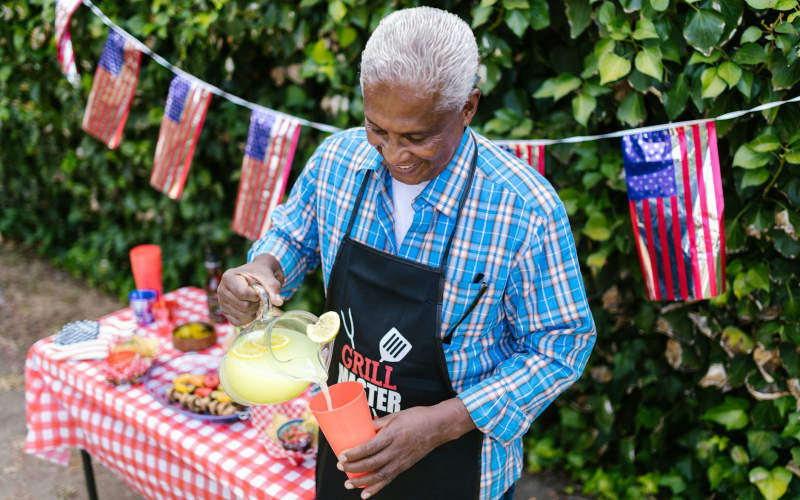
Photo by RDNE Stock project on Pexels