

I killed my first three starters before I made a single edible loaf. Three. And I cook almost every single day, so that stung. So if you’ve stumbled across sourdough tutorials that read like they were written for professional bakers with $400 mixers and a dedicated fermentation shelf — honestly, you’re not wrong. Most of them were.
But here’s the thing: sourdough is genuinely ancient. People were making it in Egypt around 1500 BCE with nothing but flour, water, and whatever wild yeast happened to be drifting through their kitchen. No banneton baskets. No Dutch ovens. No starter kits from Williams-Sonoma. You don’t need any of that to make something extraordinary.
This guide is for the person standing in their kitchen with a bowl, a bag of flour, and some stubborn determination.
What You Actually Need (And What You Don’t)
Flour, water, salt, and time. That’s the non-negotiable list.
A kitchen scale genuinely helps — baking by weight rather than volume makes a real difference, and you can grab a decent one on Amazon for around $12. Beyond that, you want a large bowl, a bench scraper (or just a regular spatula), and a Dutch oven or any heavy oven-safe pot with a lid. That’s it.
You do NOT need a stand mixer, a bread proofing basket, a specialty lame scoring tool, or anything sold inside a “sourdough starter kit” for $65.
Building Your Wild Yeast Starter from Scratch
Your starter is just flour and water that you feed daily until wild yeast moves in and colonizes it. Mix 50 grams of whole wheat flour with 50 grams of room-temperature water in a clean jar. Cover it loosely. Leave it somewhere warmish — around 75°F is ideal.
Every 24 hours, discard half and feed it fresh flour and water in the same ratio. By day 5 or 6, you should see bubbles and catch a slightly sour smell. That’s alive. That’s your starter working.
The whole wheat flour matters here. It carries more wild yeast on the bran than all-purpose does. Some bakers swap in rye — that works beautifully too, and tends to ferment even faster.
Understanding Hydration (Without the Intimidation)
Hydration is just the ratio of water to flour. A 75% hydration dough means 75 grams of water per 100 grams of flour. For your first loaf, stick to 70-75%. That dough is manageable — wet enough to open a good crumb, firm enough that you won’t want to cry while handling it.
Bakers like Chad Robertson — author of Tartine Bread, published in 2010 — work with 80%+ hydration doughs. Gorgeous results. Also genuinely difficult if you’ve never done this before.
Start lower. Get your confidence first.
The No-Knead Stretch and Fold Method
Here’s where beginners save themselves from real exhaustion. Instead of kneading for 10 straight minutes, you use a technique called stretch and fold. Every 30 minutes during the first 2-3 hours of bulk fermentation, you wet your hand, grab one side of the dough, stretch it upward, fold it over. Rotate the bowl. Repeat four times per set.
Four sets total. That’s it. Your arms will thank you, and your gluten development will be just as strong as if you’d kneaded the whole thing.
Shaping, Proofing, and the Cold Fridge Trick
After bulk fermentation (usually 4-6 hours at room temperature), shape your loaf gently into a ball or oval. No proofing basket? Line a regular bowl with a floured kitchen towel. Works perfectly fine.
Then — and this honestly changed everything for me — put it in the fridge overnight. Cold proofing slows fermentation way down, deepens the flavor dramatically, and makes scoring easier because the dough firms up considerably.
Baking in a Dutch Oven Without One
No Dutch oven? Use any heavy oven-safe pot with a lid. Even a cast iron skillet with a stainless steel bowl inverted over the top creates the steam environment you need for that crackling crust. Bake covered at 500°F for 20 minutes, then uncover for another 20-25 minutes until it’s a deep golden brown.
Bottom Line
Here’s something nobody really says out loud: your starter’s personality is regional. The wild yeast floating around San Francisco is genuinely different from what’s drifting through rural Vermont or central Texas — which is exactly why SF sourdough has that signature tang that bakers in other cities can’t fully replicate, no matter how carefully they follow the same recipe. Your homemade starter, built from your kitchen’s air, your tap water’s mineral content, your flour’s local grain — it’ll produce a loaf that literally cannot be made anywhere else on earth. That’s not marketing. That’s microbiology. And to me, that makes every imperfect, lopsided, first-timer loaf worth something genuinely special.
Frequently Asked Questions
How long does it take to make sourdough bread for beginners without a starter kit?
Plan on about 7 days total — 5-7 days to build your starter, then roughly 24 hours for your first actual bake (including overnight cold proofing). The hands-on time is maybe 30-40 minutes spread across the whole process.
Can I use all-purpose flour instead of bread flour?
Yes. Bread flour has more protein (around 12-13% vs. all-purpose’s 10-11%), which builds stronger gluten, but plenty of good loaves get made with all-purpose. Just expect a slightly denser crumb.
Why isn’t my starter bubbling after 4 days?
Temperature is almost always the culprit. Anything below 68°F slows fermentation significantly. Try moving your jar to the top of your refrigerator, near your oven’s pilot light, or inside your oven with just the light on — that last trick can push temps to a starter-friendly 75-78°F.
Do I really need to score the dough before baking?
Yes, and here’s why it matters: scoring controls where the loaf expands. Without it, the bread bursts unpredictably in whatever direction it pleases. A sharp serrated knife or even a clean razor blade works fine. One confident slash at a 30-45 degree angle is genuinely all you need.
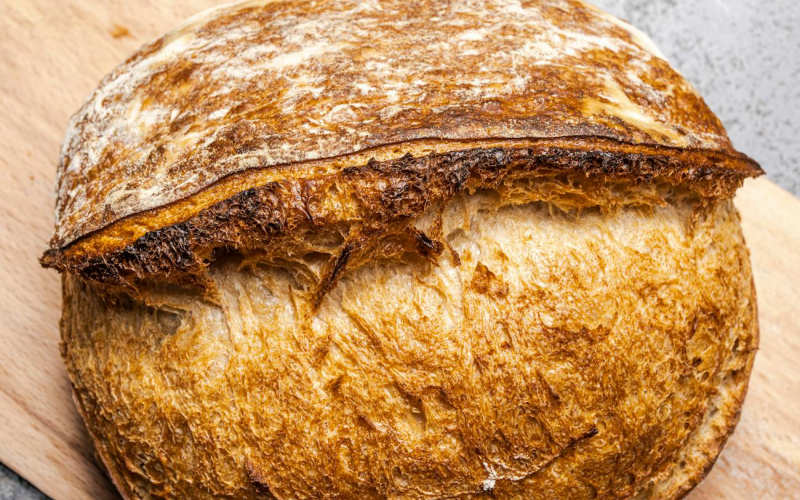
Photo by Kerim Eveyik on Pexels