
I killed my first batch. Completely. Left a jar of fermented mango on the counter for nine days in August, cracked the lid, and nearly passed out from the smell. That failure taught me more about fermentation than any YouTube tutorial ever did.
Here’s the thing nobody tells you upfront: making fermented fruit drinks at home isn’t complicated, but it is unforgiving if you skip the boring parts. The good news? Once you understand what’s actually happening inside that jar—bacteria eating sugars, producing acids, building a micro-ecosystem—you stop guessing and start making stuff that genuinely tastes incredible and does real things for your gut.
And the gut health angle isn’t hype anymore. A 2022 study from Stanford’s School of Medicine tracked 36 adults over 10 weeks and found that a diet high in fermented foods measurably increased microbiome diversity. That’s not a small claim.
Why Fermented Fruit Drinks Actually Help Your Gut
Your gut houses roughly 100 trillion microorganisms. Not a metaphor. A literal city of bacteria, fungi, and other things most people don’t want to think about while eating.
Fermented fruit drinks introduce live cultures—specifically lactobacillus strains in most fruit ferments—that crowd out harmful bacteria and churn out short-chain fatty acids your gut lining actually feeds on. The organic acids produced during fermentation (mainly lactic acid and acetic acid) also drop the pH of your digestive environment, which makes life considerably harder for pathogens.
But here’s what I find genuinely fascinating: the fruit itself matters more than most people realize. Fruits loaded with natural sugar—mangoes, cherries, pineapple—ferment faster and throw up more diverse bacterial populations than low-sugar options like cranberries.
The Best Fruits to Start With
Don’t start with something exotic. Seriously.
Ginger beer using fresh ginger root is the most forgiving entry point—fast (3-5 days), and failure announces itself loudly before you ever taste it. Wild-fermented apple juice (essentially hard cider without the alcohol ambition) works beautifully because apple skins carry wild yeast naturally. Grape-based ferments come third on my list, mostly because the tannins act as a built-in preservative.
For your first real fruit drink ferment, I’d steer you toward a simple ginger bug—a starter culture made from fresh ginger, sugar, and water—then use it to ferment fruit juice. It’s the same basic logic as sourdough starter. Plan on 5-7 days to grow a healthy bug before you even touch your drink.
Equipment You Actually Need (Nothing Fancy)
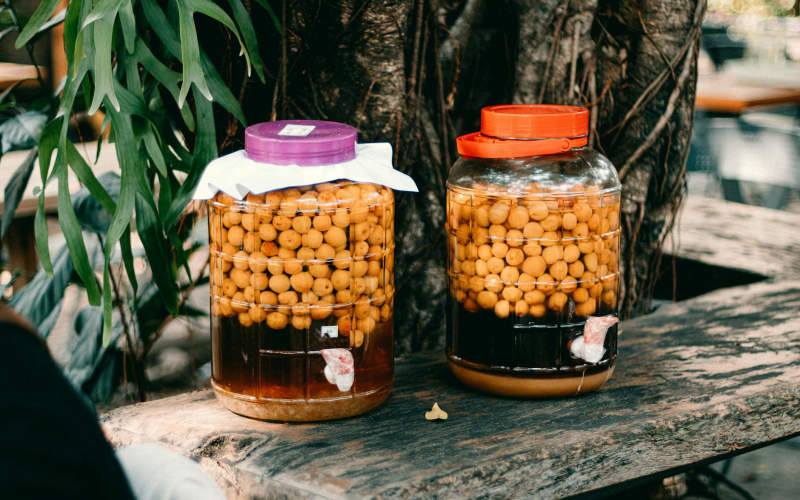
Wide-mouth mason jars. Cheesecloth. A rubber band. That’s genuinely most of it.
You’ll want a kitchen scale because ratios matter more than volume here, and a thermometer because fermentation drags below 65°F and starts producing off-flavors above 85°F. The sweet spot sits around 70-75°F—which, depending on your house, might mean your kitchen counter or the top of your refrigerator (warmer up there than you’d expect).
Skip the fancy airlocks for fruit drinks. Unlike vegetable ferments, most fruit drinks actually need some oxygen contact in the early stages.
The Basic Salt-to-Sugar Ratio (And Why It Matters)
For fruit drink ferments using a ginger bug or wild fermentation, shoot for roughly 2-3% sugar by total liquid weight. So for 1 liter of liquid, that’s 20-30 grams of sugar. Too little and fermentation stalls out. Too much and you’ll be cleaning jar lids off your ceiling at 2am.
I learned that second part personally.
Spotting the Difference Between Good and Bad Fermentation
White sediment? Fine. Expected, actually. Kahm yeast—that thin white film that forms on top—is annoying but harmless. Pink or orange fuzz? Pour it out. No negotiation.
A healthy ferment smells tangy, slightly fruity, a little funky—but never rotten. Trust your nose more than any recipe timer.
How to Store and When to Drink
Move bottles to the fridge once they hit your preferred tartness. Cold slows fermentation dramatically but doesn’t kill it—your drink keeps developing flavor over weeks.
Drink within 3-4 weeks for the best probiotic activity.
Bottom Line
Here’s something I haven’t seen written anywhere else: the gut health benefit from your homemade fermented fruit drink isn’t just about the bacteria you’re introducing—it’s about the bacteria you’re selecting for in your own gut by feeding them the prebiotic acids and fibers they thrive on. You’re not just adding passengers. You’re redesigning the habitat. That’s a fundamentally different way to think about why this stuff works, and honestly, it changes how consistently you’ll actually drink it.
Frequently Asked Questions
How long does it take to make fermented fruit drinks at home?
Basic ginger bug ferments are drinkable in 7-10 days total—5-7 days to build the starter, then 2-3 days for the actual drink fermentation. More complex wild fruit ferments can stretch to 2-3 weeks.
Can homemade fermented fruit drinks replace probiotic supplements?
They can complement supplements, but the bacterial strains in homemade ferments are more diverse and often more bioavailable than anything encapsulated. A 2021 analysis in Frontiers in Microbiology found wild-fermented beverages contained between 8 and 23 distinct bacterial strains per sample—most supplements carry 2-5.
Is there alcohol in fermented fruit drinks?
Yes, a small amount—typically 0.5-1.5% ABV in most home fruit ferments, which puts them in the same neighborhood as commercial kombucha. Ferment longer and the alcohol climbs. Keep ferments under 5 days if that’s a concern for you.
What if my ferment doesn’t bubble?
Your environment is probably too cold. Move the jar somewhere warmer (top of the fridge or near a heat vent both work) and give it another 24-48 hours before you write it off as dead.
Photo by 🇻🇳🇻🇳Nguyễn Tiến Thịnh 🇻🇳🇻🇳 on Pexels